






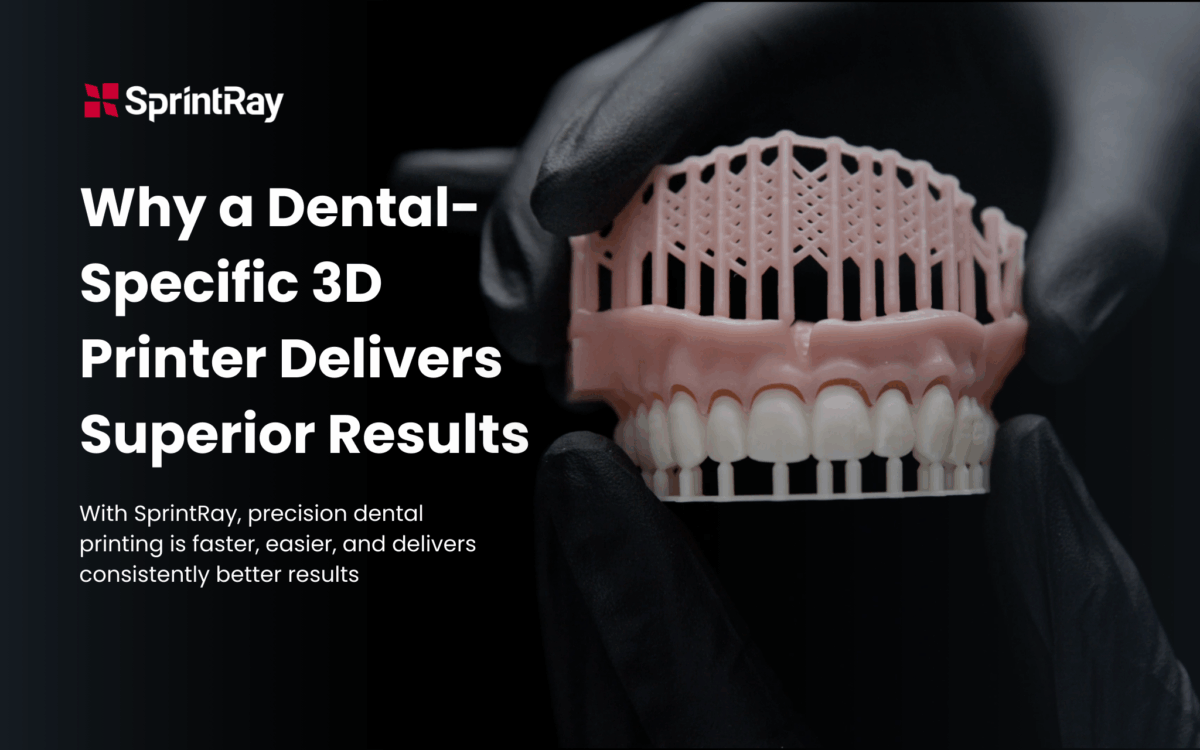
SprintRay recently announced its acquisition of EnvisionTEC’s dental portfolio, adding over 200 patents and two decades of dental innovation to an already laser-focused platform. This isn’t just another corporate acquisition. It’s proof that when it comes to dental 3D printing, specialization wins.
For dental professionals evaluating their first or next dental 3D printer, this acquisition raises a critical question: Does it really matter if your printer was built specifically for dentistry, or can a multi-industry solution deliver the same results?
The answer, as thousands of EnvisionTEC customers learned the hard way, is that focus matters more than you might think.
How the EnvisionTEC Acquisition Transforms SprintRay’s Capabilities
The EnvisionTEC acquisition isn’t about SprintRay getting bigger—it’s about getting deeper into dental innovation. Here’s what just joined the SprintRay ecosystem:
200+ Patents of Pure Dental Innovation
EnvisionTEC developed more than 200 patents spanning dental 3D printing hardware and materials over 20+ years. These aren’t general manufacturing patents adapted for dentistry—they’re innovations born from solving actual dental challenges. Al Siblani’s engineering team was developing advanced 3D printing solutions for dentistry in 2006-2008 that wouldn’t be adopted by other industries for another decade.
Lab-Focused Technologies Meet Chairside Excellence
While SprintRay has dominated chairside printing, EnvisionTEC brought decades of dental lab expertise. This acquisition creates the industry’s most comprehensive dental 3D printing ecosystem—from 30-second temp crowns to high-volume lab production capabilities.
Proven Materials Portfolio Integration
EnvisionTEC’s materials, including the widely used Flexcera resin, join SprintRay’s Biomaterial Innovation Lab portfolio. The planned cross-platform validation means SprintRay resins tested on EnvisionTEC platforms and vice versa—expanding your material options while maintaining dental-specific validation.
Complete Workflow Coverage
SprintRay’s 15+ dental workflows now expand to comprehensive lab capabilities. Whether you’re printing surgical guides chairside or sending complex prosthetic work to your lab, one ecosystem handles both with seamless integration.
The immediate impact for dental practices is clear: future-proofing through a single vendor relationship that covers both in-office printing and lab-sent work, with material compatibility guaranteed within a dental-focused ecosystem.
Dental-Specific Design in Action
The difference between dental 3D printers and multi-industry solutions isn’t just marketing—it’s measurable in every component. Here’s how dental-specific design translates to better outcomes:
Build Platform Optimization That Actually Matters
The SprintRay Pro 2’s 18.8 x 10.5 x 20 cm build volume wasn’t chosen arbitrarily. Every millimeter was designed around actual dental part dimensions. While general manufacturing printers optimize for random part sizes, the Pro 2 can print 30 full-arch dental models simultaneously—a capability that comes from understanding how dental practices actually work.
The Arch Kit takes this further, doubling speed for restorative work through a purpose-built insert designed specifically for crown and bridge geometries. Try achieving that efficiency with a printer designed for jewelry, miniatures, and dental work as an afterthought. You can’t.
Materials Science Built for Mouths, Not Manufacturing
SprintRay’s Biomaterial Innovation Lab has one job: create materials that can handle everything your patients throw at them. Take OnX Tough 2—it’s FDA-cleared for hybrid dentures because it was built to withstand actual chewing forces (and, on the other hand, not be too hard), not just look good on a lab bench. Meanwhile, Ceramic Crown material comes in translucency options that match real dental shade guides, not whatever looks cool under studio lighting then doesn’t match the patient’s smile.
Digital Temp resin shows how different dental really is. It’s designed to be biocompatible in someone’s mouth and easy to remove when the permanent restoration is ready. Try finding those requirements in general manufacturing.
Now with the EnvisionTEC acquisition, this expertise just doubled. Proven lab materials like Flexcera are joining the SprintRay family, bringing decades of real-world dental lab experience with them. These aren’t materials adapted from other industries—they were born in dental labs.
Software That Speaks Dentistry
Think about the difference between using dental software versus trying to make general software work for dentistry. SprintRay’s software knows you’re printing crowns, not miniature figurines. Click one button and it automatically arranges your crowns to fit the maximum number on the build platform. The support structures? They’re designed so you can actually remove them without breaking delicate margins—something that matters when you’re fitting a crown, not printing a prototype.
Most importantly, the software understands infection control. It knows you need to factor in cleaning protocols that simply don’t exist when you’re printing industrial parts.
Speed Through Specialization
SprintRay’s patent-pending 35 μm Optical Panel delivers precision levels chosen specifically for dental fit requirements, not general manufacturing tolerances. The 385 nm light engine uses wavelength optimization for dental resin chemistry. Eight arches in under 30 minutes becomes achievable when every component—from light engine to resin chemistry to build platform design—works in perfect harmony for dental applications.
Why Using Products With a Dental Focus Matters More Than Ever
The EnvisionTEC story serves as a sobering reminder of what happens when multi-industry companies shift priorities. Desktop Health acquired EnvisionTEC, then abandoned thousands of dental customers when broader business pressures demanded focus elsewhere. Practices found themselves with unsupported equipment, discontinued materials, and no service pathway.
SprintRay’s immediate response? “We’ve got your back. Continue printing.” We didn’t just offer discounts to convert customers—we committed to supporting existing EnvisionTEC equipment and maintaining material supply chains.
This isn’t an isolated incident. When revenue pressures hit multi-industry companies, they naturally focus on their largest markets. Dental becomes a “niche” that gets deprioritized, leaving practices stranded with expensive equipment that loses support and material availability.
That will never happen with SprintRay, because SprintRay is only focused on digital dentistry.
SprintRay’s Commitment Proof Points:
Every dollar of SprintRay’s revenue depends on dental success—there are no competing priorities from automotive, aerospace, or consumer goods divisions. The acquisition strategy focuses on expanding dental capabilities, not diversifying into other industries. Taking on competitors’ abandoned customers proves our long-term commitment, while continued R&D investment flows exclusively into dental applications.
When you choose a SprintRay dental 3D printer, you’re not just buying equipment—you’re betting on the company’s long-term commitment to your industry.
Cost Considerations
Equipment costs represent just the tip of the total ownership iceberg. Our recent analysis breaks down the hidden costs of workflow optimization, training time, and material compatibility that significantly impact your investment.
The key insight: dental-specific design often delivers faster returns through reduced setup time and optimized workflows, making the specialization premium worthwhile for practices serious about 3d printing in dental industry applications.
When SprintRay’s Dental Focus Delivers Maximum Advantage
High-Volume Practices
If you’re printing cases all day long, you’ll notice the difference immediately. The software knows you’re arranging crowns, not random parts, so it packs them efficiently on the build platform. Your intraoral scanner talks directly to the printing software without you having to wrestle with file formats. It’s the difference between a workflow built for dentistry versus trying to make general manufacturing software work for dental cases.
Quality-Critical Applications
When you’re placing an implant, a surgical guide that’s off by even a fraction can mean the difference between a perfect placement and an expensive do-over. Crown margins need to fit precisely or your patient will feel it every time they bite down. This is where dental-specific materials and validation really matter—because “close enough” isn’t good enough when it’s going in someone’s mouth.
Full-arch cases are especially tricky because you need support structures that won’t damage delicate features when you remove them. General manufacturing software doesn’t understand that breaking a crown margin is different from breaking a prototype part.
Growth-Minded Practices
As your practice grows, you want equipment that grows with you. Maybe you start with simple models, then add surgical guides, then partner with labs for complex cases. With a dental-focused platform, you’re not starting over each time—you’re building on what you already know. Plus, when new dental applications emerge (and they will), dental companies develop them first while multi-industry companies are busy with their latest automotive project.
Practices Valuing Support Certainty
Here’s something to consider: when you call for help, do you want to talk to someone who understands dental workflows, or someone who also supports jewelry makers and miniature hobbyists? Dental-only companies live or die by keeping dental professionals happy. Their support teams know the difference between a crown prep and a surgical guide, and their user communities are solving the same problems you face every day.
Proving The Advantage Of Specialization
The EnvisionTEC acquisition demonstrates that dental specialization delivers measurable advantages: faster workflows, better materials, more reliable support, and guaranteed long-term commitment. By combining two decades of dental-specific engineering with modern platform capabilities, SprintRay proves that when your dental 3D printer was built specifically for dentistry, every component works harder for your practice’s success.
The choice between dental-specific and multi-industry solutions has never been clearer. One approach treats dentistry as the entire focus; the other treats it as one market among many.
Ready to experience the dental-specific advantage? Schedule a SprintRay demonstration and see how purpose-built design translates to better outcomes for your practice.