






Since its emergence, dental 3D printing has had a fundamental physics problem: viscosity.
The materials dentists actually want to use—highly-filled ceramics, ultra-strong composites, bioactive resins—are too thick to flow through conventional systems.
For decades, this has forced an impossible choice. You could have fast chairside printing with weaker materials, or you could have strong materials that required lab processing. The entire industry built workarounds, but nobody solved the core problem.
Until Midas and Digital Press Stereolithography changed everything.
What Makes Digital Press Stereolithography Different
SprintRay invented Digital Press Stereolithography (DPS) to solve what everyone else couldn’t: how to 3D print materials that are too thick for traditional systems.
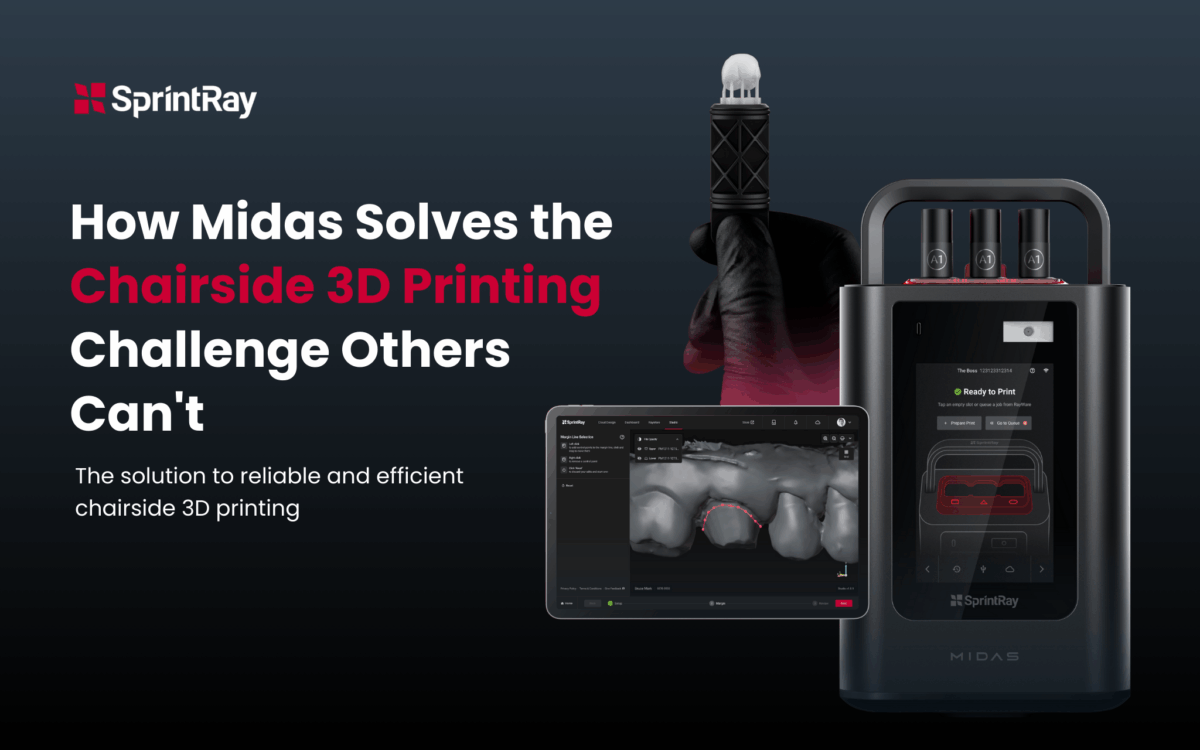
Here’s the breakthrough: Instead of trying to make viscous materials flow like water, Midas uses pressurized resin capsules that push material exactly where it needs to go. Think of it like the difference between pouring honey and using a syringe—suddenly, viscosity doesn’t matter.
The Capsule System Revolution
Every Midas capsule contains:
- Pressurized resin chamber with your material
- Built-in build platform
- Everything needed for up to 3 restorations
No tanks. No mess. No viscosity limitations. Just scan the QR code, place the capsule, and press print.
What This Means for Your Practice
Materials That Were Impossible Are Now Routine
The first Midas material has over 70% ceramic filler—a concentration that would clog any traditional 3D printer instantly. But for Midas? It prints in under 8 minutes.
This opens up a world of possibilities:
- True ceramic-composite crowns chairside
- Ultra-high strength materials that rival milled ceramics
- Future materials that material scientists couldn’t even consider before
The Workflow You’ve Always Wanted
Scan. Place. Press. That’s it.
- Upload your scan to AI Studio (integrates with 3Shape, Dexis, Medit)
- AI generates your restoration automatically
- Place up to 3 capsules in Midas
- Print multiple restorations in 10 minutes
- Remove and you’re done—no post-processing
Zero Training, Zero Maintenance
Remember learning CAD/CAM? The steep learning curve, the constant maintenance, the inevitable downtime? Midas eliminates all of that.
- No resin tanks to clean
- No build platforms to level
- No failed prints from contamination
- Medical device tracking built into every capsule
Why Competitors Can’t Copy This
The Patent Advantage
Digital Press Stereolithography is patent-pending technology. The pressurized capsule system, the hydrodynamic printing process, the entire workflow—it’s all protected IP that took SprintRay years to develop.
The Material Science Breakthrough
This isn’t just about hardware. DPS removes the boundaries that chemists have faced for decades. When viscosity is no longer a limitation, material scientists can focus purely on strength, aesthetics, and biocompatibility.
The result? SprintRay’s partnership with Ivoclar is already producing materials that simply couldn’t exist before.
A New Era of Chairside Capability
Dr. Wally Renne, co-founder of MOD Institute, called Midas “the biggest breakthrough in dentistry since September 1985, when the first CEREC inlay was milled.”
That’s not hyperbole. This technology transforms what’s possible in your operatory.
The Competitive Reality Check
While you’re reading this, early adopters are already:
- Printing ceramic crowns in 8 minutes
- Offering same-day restorations with unprecedented strength
- Attracting patients with cutting-edge technology
- Reducing lab costs while increasing case acceptance
The question isn’t whether this technology will become standard—it’s whether you’ll be early to market or playing catch-up.
Ready to See It in Action?
Midas transforms how we think about 3D printing and changes what’s possible in your practice. From impossible materials to effortless workflow, this is the chairside revolution practitioners have been waiting for.
Watch the Midas Technology Demo →
Experience the future of chairside restorations. See Digital Press Stereolithography print ceramic-filled materials that others can’t even attempt.
The materials revolution starts here. The question is: will you lead it?