






You’ve heard about it at conferences. Seen competitors advertise it. Read about it in journals.
“Same-day crowns. No temporaries. No second visits.”
It sounds appealing. It also sounds complicated. (And expensive.)
And somewhere in the back of your mind, you’re wondering: Is this just marketing hype, or is this actually the future of restorative dentistry?
Here’s where we are: Chairside 3D printing isn’t coming. It’s here. And it’s not a gimmick—it’s the modern standard for how modern practices deliver restorative care.
Chairside 3D printing is now identified as ‘one of the most significant emerging trends in the global dental 3D printing market’, revolutionizing how dental procedures are performed by enabling dentists to create customized devices directly in their practices during a single visit.
But what does “chairside 3D printing” actually mean? And more importantly, what does it mean for your practice?
Let’s cut through the buzzwords and talk about your daily reality.
What “Chairside” Actually Means
The term sounds fancy, but the concept is simple:
Chairside = producing the restoration in your practice while the patient is there (or returns the same day), rather than sending it to an external lab and waiting.
That’s it.
You’re not doing anything fundamentally different clinically. You’re still:
- Examining and diagnosing
- Prepping teeth
- Designing restorations
- Cementing crowns
The difference is where the fabrication happens and how fast the patient gets their final restoration.
Traditional Process
Patient’s tooth → Impression → Lab (offsite) → Wait 1-2 weeks → Second appointment
Chairside Process
Patient’s tooth → Digital scan → Printer (your office) → Wait 30-90 minutes → Deliver same day
The shift: Production moves from an external lab you can’t control to equipment in your practice you can control. Will it fit properly? You’ll know right away. Anxiety, gone.
Two Types of Chairside Technology
When practices talk about “chairside,” they’re usually referring to one of two technologies. They’re different, and understanding the distinction matters.
Chairside Milling (CEREC, E4D)
How it works: Removes material from a solid block using a rotating bur
Materials: Ceramic blocks, composite blocks
Speed: 10-20 minutes per crown
Investment: $80,000-150,000 complete system
Best for: Monolithic restorations, immediate delivery
The pioneer approach: Milling has been around since the 1980s and established the concept of same-day dentistry.
Chairside 3D Printing (SprintRay, others)
How it works: Builds restoration layer-by-layer using light-cured resin
Materials: Biocompatible resins, ceramic-filled composites
Speed: 30-60 minutes per print + 20 minutes for post-processing
Investment: $20,000-22,000 complete system
Best for: Complex geometries, multiple applications, material flexibility
The expanding approach: 3D printing offers versatility beyond just crowns—surgical guides, night guards, dentures, aligners, models.
Both are “chairside.” Both enable same-day delivery. The difference is methodology and flexibility.
For this article, we’re focusing on chairside 3D printing with SprintRay, but the core concept—production in your practice during the patient visit—applies to both.
What Changes for Patients
Let’s start with your patient’s perspective, because that’s what drives everything.
The Old Way (Traditional Lab)
Appointment 1:
- “We’ll prep your tooth today and fit you with a temporary crown.”
- “Come back in two weeks when the permanent crown arrives from the lab.”
- “Try not to chew on that side.”
- “Call us if the temporary comes off.”
Between Visits:
- The patient deals with temporary crown discomfort.
- Worries about it falling off at dinner.
- Takes time off work or arranges childcare/pickups again for appointment 2.
- Pays another copay.
Appointment 2:
- Numb the patient again
- Remove temporary.
- Hope the permanent crown fits.
- Make adjustments if needed.
- Finally cement and done.
Patient thinking: “I had to come back twice and deal with a temporary for two weeks for one tooth? This is why I hate coming to the dentist.”
The New Way (Chairside 3D Printing)
Single Appointment:
- “We’re going to prep your tooth and make your crown right here today.”
- “You can wait in our lounge, run a quick errand, or grab lunch nearby.”
- “Come back in about an hour, and we’ll put your permanent crown in.”
Patient thinking: “Wait, I’m getting my actual crown today? No temporary? One appointment? This is amazing.”
Or The Next-Morning Option:
- “We’ll prep your tooth today, print your crown tonight, and you’ll come back tomorrow morning for a 30-minute appointment to place your crown.”
- That’s still dramatically better than two weeks with a temporary
What Changes for Your Practice
The improvement to your patient’s experience is obvious. But what does chairside 3D printing actually change operationally?
Timeline Control
Traditional: Lab controls your timeline. Backed up? You wait. Holiday week? Wait longer. Rush case? You pay extra and still wait.
Chairside: You control the timeline. Need it in an hour? Done. Need it tomorrow? Done. Emergency Friday afternoon? No problem.
Impact: This gives your practice the flexibility to say “yes” to cases you’d previously have to delay or refer out.
Quality Control
Traditional: The crown comes back from lab. You put it in but unfortunately, it doesn’t fit quite right. Then, you either have to send it back and have a new crown made, or adjust it chairside as best you can with the tools at your disposal. The patient has already been waiting two weeks and is pretty darn frustrated.
Chairside: Design the crown and print it right then and there. Let the patient run an errand or grab a bite to eat while they wait. Check the fit before the patient leaves. If the fit isn’t perfect, you can adjust and reprint without delay.
The Impact: Fewer compromises on fit. Immediate iteration if needed.
Revenue Timing
Traditional: Prep appointment → Wait 2 weeks → Delivery appointment → Bill insurance → Wait 30-60 days → Collect payment.
Total time from prep to payment: 6-10 weeks
Chairside: Prep and deliver same day → Bill insurance → Wait 30-60 days → Collect payment. Total time from prep to payment: 4-8 weeks
Impact: Get paid sooner. Improve cash flow.
Schedule Flexibility
Traditional: You need to schedule two appointments per crown, hoping your lab timing aligns with your patient’s availability.
Chairside: One appointment (or same-day split). Less juggling.
Impact: Fewer no-shows and simplified scheduling.
Emergency Capacity
Traditional: Your patient breaks their crown on a Friday afternoon. The best you can do is to offer them a temporary while you wait for the lab and hope they can come back next week.
Chairside: Same Friday afternoon crown break, but now, you scan, print, and fit a fresh crown before the end of the day.
Impact: You can turn emergencies into single-session completed treatments, vastly improving your patient experience and gaining revenue you’d otherwise lose to your competition, who can handle quick turnarounds (because they already have chairside 3D printing capabilities).
Premium Pricing Opportunity
Here’s what many practices discover: patients will pay MORE for same-day delivery.
Traditional crown fee: $1,200
Same-day crown fee: $1,380-1,500 (15-25% premium)
Why patients pay more:
- Convenience of one visit vs. two
- No temporary crown hassle
- No second time off work
- No second copay
- Immediate gratification
Impact: Not only will you save on lab costs, but you can also potentially increase revenue per case.
The Impact on your Case Acceptance
When you can say “We can do this today” instead of “Come back in two weeks,” something changes:
Patients who were resistant about scheduling two appointments say yes to one. Patients who would have delayed treatment for months get it done today.
Bottom line: Your case acceptance rates will skyrocket because you’re able to reduce barriers, be respectful of your patients’ time, and deliver same-day results.
What Changes Competitively
Here’s the uncomfortable truth: your market is changing whether you adopt chairside technology or not.
What Patients Expect Now
We live in an Amazon Prime world. Patients expect:
- Same-day delivery
- Immediate results
- Minimal waiting
- Fewer trips
Dentistry isn’t immune to these expectations.
When patients search “dentist near me,” they’re comparing practices. The ones advertising “same-day crowns” catch attention.
The Early Adopter Advantage
15% of dental practices in the United States now have at least one 3D printer, up from nearly zero just five years ago.
Translation: In most markets, 85% of practices DON’T offer chairside 3D printing yet.
If you’re in that 15% who do, you have a competitive advantage. You’re “the practice with the technology.” Patients will specifically seek you out.
The catch? The window for this “early adopter advantage” is closing. As more practices bring chairside capabilities into their practice, it shifts from a differentiator to an expectation.
Five years from now, same-day crowns might be table stakes, not a unique selling point.
The question is whether you adopt while there’s competitive advantage, or wait until patients expect it and you have no choice.
Next Steps: Understanding Your Options
If you’re considering chairside 3D printing, here’s how to move forward:
- See the technology in action
Schedule a SprintRay demo to watch the complete workflow and ask specific questions about your practice. - Understand the training timeline
Read about the realistic learning curve—it’s shorter than you think. - See how it integrates
Learn how SprintRay fits into existing workflows without restructuring your practice.
Chairside 3D printing isn’t about abandoning everything you’ve built. It’s about adding capability that improves patient care, practice economics, and competitive positioning.
The practices thriving in 2025 and beyond are the ones adapting to where dentistry is going, not clinging to where it’s been. SprintRay is here to be your dedicated partner with a complete ecosystem that delivers reliable, cutting-edge results.
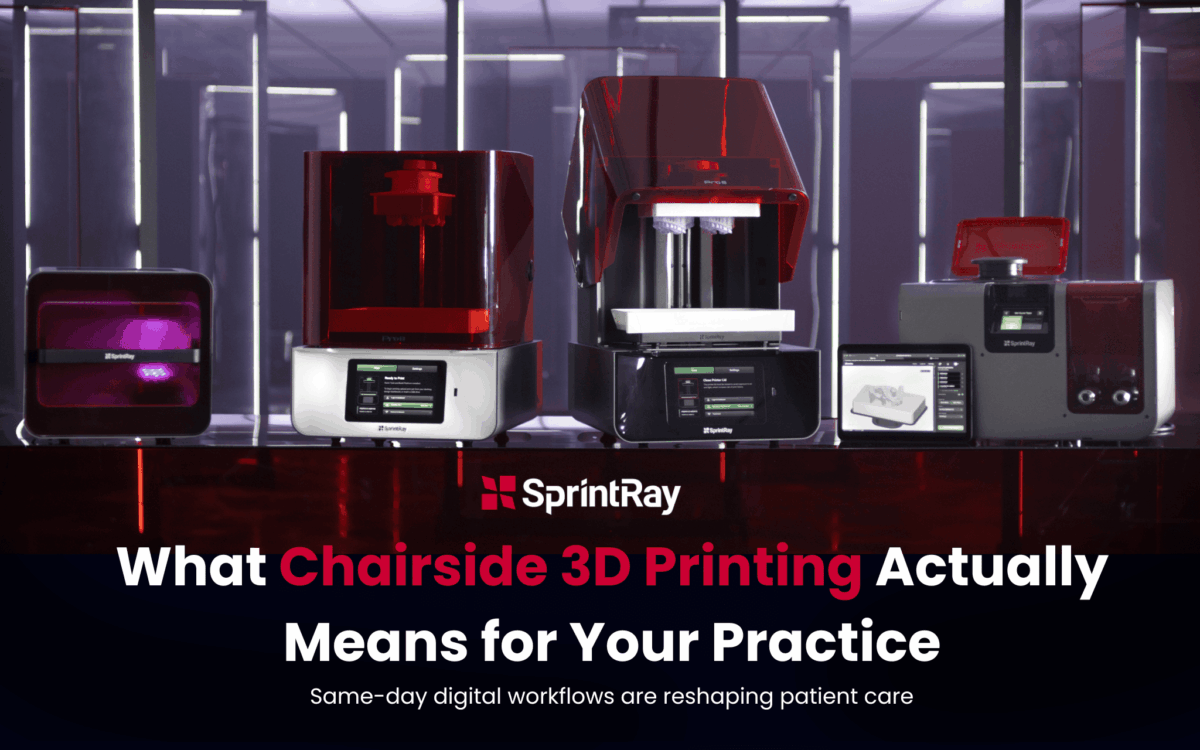
Chairside 3D printing with SprintRay Pro 2 enables same-day dental restorations, giving practices control over timeline, quality, and patient experience while dramatically improving economics.