






When evaluating dental 3D printing solutions, selecting the right dental resin often becomes the biggest concern for practices. The question isn’t just about print quality—it’s about whether you can trust the biocompatible dental resin you’re placing in your patients’ mouths for years to come.
Your practice has built its reputation on quality care, and introducing dental materials with questionable biocompatibility or durability could compromise patient outcomes. The challenge becomes even trickier when the 3D printing dental materials market is full of options with wildly different levels of clinical validation.
Understanding the difference between FDA-approved dental materials and general biocompatible claims could be the key to confidently moving forward with chairside restorations.
Understanding FDA Clearance vs. General Biocompatible Claims
Manufacturers of dental 3D printing materials will often use terms like “biocompatible,” “dental-grade,” and “clinically tested.” While they sound similar, they actually represent different levels of testing and regulatory approval.
FDA-approved dental materials undergo rigorous evaluation processes. When a dental resin receives FDA clearance for a specific application, manufacturers must submit extensive biocompatibility testing, clinical data, and manufacturing quality controls for agency review. The FDA evaluates this evidence and determines whether the material is safe and effective for that particular clinical use.
General “biocompatible dental resin” claims, however, may be based on limited testing or validation for different applications entirely. A resin might be perfectly safe for temporary restorations but inappropriate for long-term fixed prosthetics. Without FDA clearance for your specific application, practices essentially rely on manufacturer assertions rather than regulatory validation.
SprintRay OnX Tough 2: The First FDA-Cleared Solution
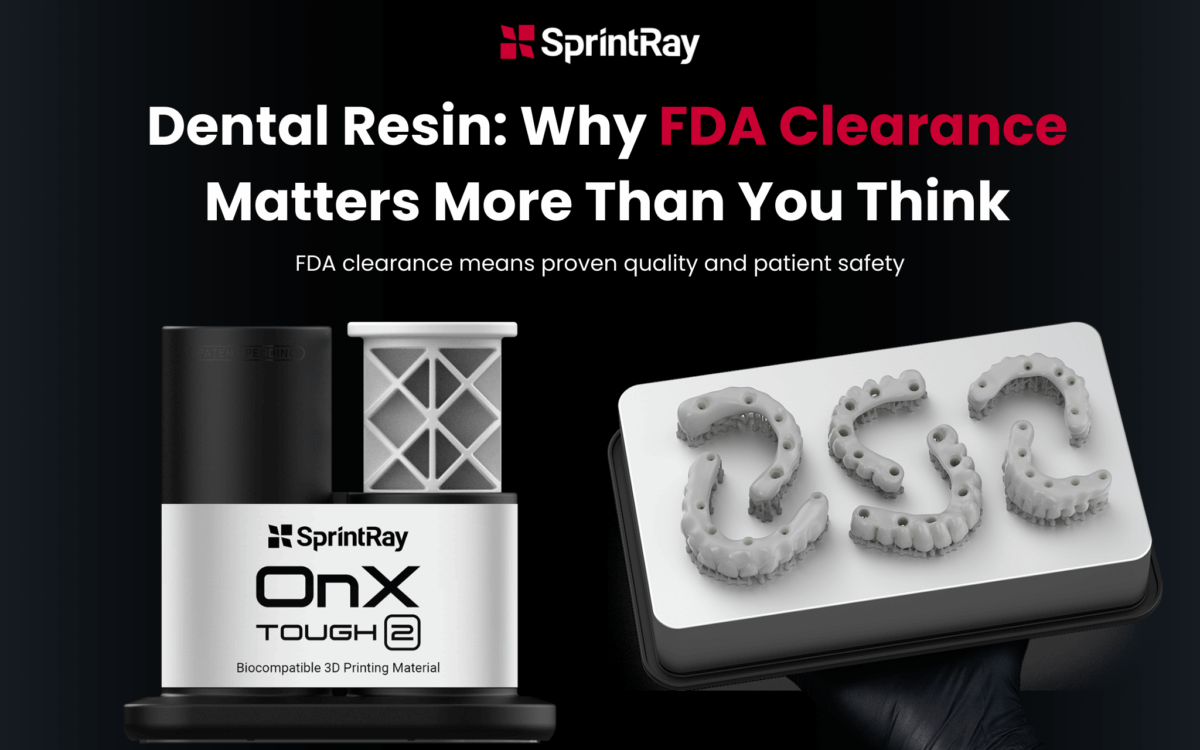
This regulatory distinction becomes particularly relevant when examining the best dental resin for 3D printing hybrid dentures. SprintRay’s OnX Tough 2 represents the first dental resin to receive FDA clearance specifically for fixed hybrid dentures, setting a new standard for 3D printing dental materials validation.
While other manufacturers market their dental 3D printing resin products for various applications, OnX Tough 2 has completed the comprehensive FDA approval process specifically for fixed hybrid denture applications. This clearance required extensive clinical data, biocompatibility testing, and manufacturing quality controls—all evaluated and approved for this exact clinical use.
Dental Resin Strength Testing: Performance Data That Matters
FDA clearance is important, but performance is what really matters in your day-to-day practice. OnX Tough 2 stands out because of how it’s actually built. SprintRay uses their NanoFusion™ technology to evenly distribute ceramic particles throughout the resin, which makes the final product significantly stronger and more durable.
In comparative dental resin strength testing, OnX Tough 2 consistently outperforms standard 3D printing dental materials in critical performance areas:
- Flexural strength: >150 MPa (significantly higher than typical 80-120 MPa range)
- NanoFusion™ reinforcement: Enhanced structural integrity and wear resistance
- Impact resistance: 15x higher than conventional dental resins
- Color stability: Minimal variation under extended clinical conditions
Here’s what matters: higher flexural strength in dental 3D printing resin means fewer fractures when patients are actually chewing. Superior impact resistance means the prosthetic can handle normal wear and tear, plus the occasional accident. These aren’t just lab numbers—they translate directly to fewer remakes and happier patients.
Clinical Outcomes and Practice Integration
Early clinical adoption data supports this biocompatible dental resin’s performance profile. Practices implementing this FDA approved dental material report:
- Fracture rates: Less than 2% failure rate within 18 months
- Patient acceptance: 95%+ satisfaction scores
- Clinical predictability: Consistent performance across diverse patient presentations
- Chairside efficiency: Material machines effectively without chipping during adjustments
These outcomes represent a substantial improvement over earlier generation dental 3D printing resin options, where some practices experienced failure rates exceeding 15% within the first year of service.
The SprintRay ecosystem integration further enhances clinical outcomes. This dental resin is specifically formulated for SprintRay Pro S series printers, ensuring optimal printing parameters and consistent results. This printer-material optimization enables practices to print up to 10 fixed hybrid dentures in under 30 minutes while maintaining clinical quality standards.
Strategic Considerations for Dental 3D Printing Materials
Selecting the best dental resin for 3D printing significantly influences the success of chairside restoration integration. When evaluating biocompatible dental materials for fixed hybrid dentures, several factors warrant consideration:
Regulatory foundation: FDA approved dental materials provide documented safety and efficacy data, reducing clinical uncertainty and potential liability concerns.
Performance predictability: Established dental resin strength testing and clinical validation enable more accurate treatment planning and patient communication.
Professional credibility: The ability to discuss FDA approved dental 3D printing materials with patients demonstrates commitment to evidence-based treatment approaches.
Workflow integration: Dental materials designed for specific printer ecosystems typically deliver more consistent results and simplified protocols.
OnX Tough 2 addresses each of these considerations while providing the unique advantage of being the only dental resin specifically FDA-cleared for fixed hybrid denture applications.
Implementation and Next Steps
Successful chairside restoration programs require careful evaluation of dental 3D printing materials. The distinction between FDA approved dental resins and general biocompatible alternatives represents a fundamental decision point that influences both clinical outcomes and practice risk management.
OnX Tough 2 provides practices with regulatory clarity, performance predictability, and clinical confidence—essential elements for sustainable dental 3D printing integration. The material’s FDA approval for fixed hybrid dentures, combined with documented dental resin strength testing results and SprintRay ecosystem integration, addresses the primary concerns practices face when adopting digital restoration workflows.
For practices evaluating the best dental resin for 3D printing applications, the regulatory and performance advantages of FDA approved dental materials warrant serious consideration. The investment in validated biocompatible dental resin and integrated systems typically translates to improved clinical outcomes and reduced implementation complexity.
Evaluate the Best Dental Resin for Your Practice
If your practice is considering chairside restoration capabilities, dental resin selection should be based on clinical evidence, regulatory clearance, and performance validation rather than marketing claims alone. The difference between FDA approved dental 3D printing materials and unvalidated alternatives extends beyond regulatory compliance to encompass clinical predictability and professional confidence.
Request a free dental sample to evaluate OnX Tough 2’s performance, or schedule a consultation with SprintRay’s dental experts to learn how regulatory clearance translates to practical advantages in your restoration workflow.
[Request Free Dental Sample] | [Schedule a Demo]
When selecting biocompatible dental resin for long-term patient care, regulatory clearance and performance validation provide the foundation for confident clinical decision-making.