






You used AI this morning. Probably before you finished your coffee.
Your phone unlocked with your face. Your car suggested a faster route to the office. Your inbox sorted itself, burying the spam and surfacing the messages that actually matter. Maybe your watch flagged an irregular heart rhythm or simply told you it’s time to get up.
None of that felt like “artificial intelligence.” It just felt like part of your daily routine.
That’s the thing about AI that actually works, it disappears into the workflow. You don’t think about the machine learning model behind your navigation app. You just trust that it knows where the traffic is and follow the blue line.
So here’s the question worth sitting with: if you already trust AI to manage your commute, your communications, and your health data, why is your practice still doing things the slow way?
The Gap Between Consumer AI and Dental Practice Technology
Most dentists interact with sophisticated AI dozens of times a day outside the office. Predictive text. Voice assistants. Fraud detection on credit card transactions. Streaming recommendations. These systems learn, adapt, and improve continuously and nobody thinks twice about relying on them.
But inside the practice, the conversation around AI often stalls. It gets tangled up in skepticism, confusion about what it actually does, or a vague sense that the technology isn’t ready yet.
Meanwhile, the technology has been ready. And it’s already working in thousands of practices.
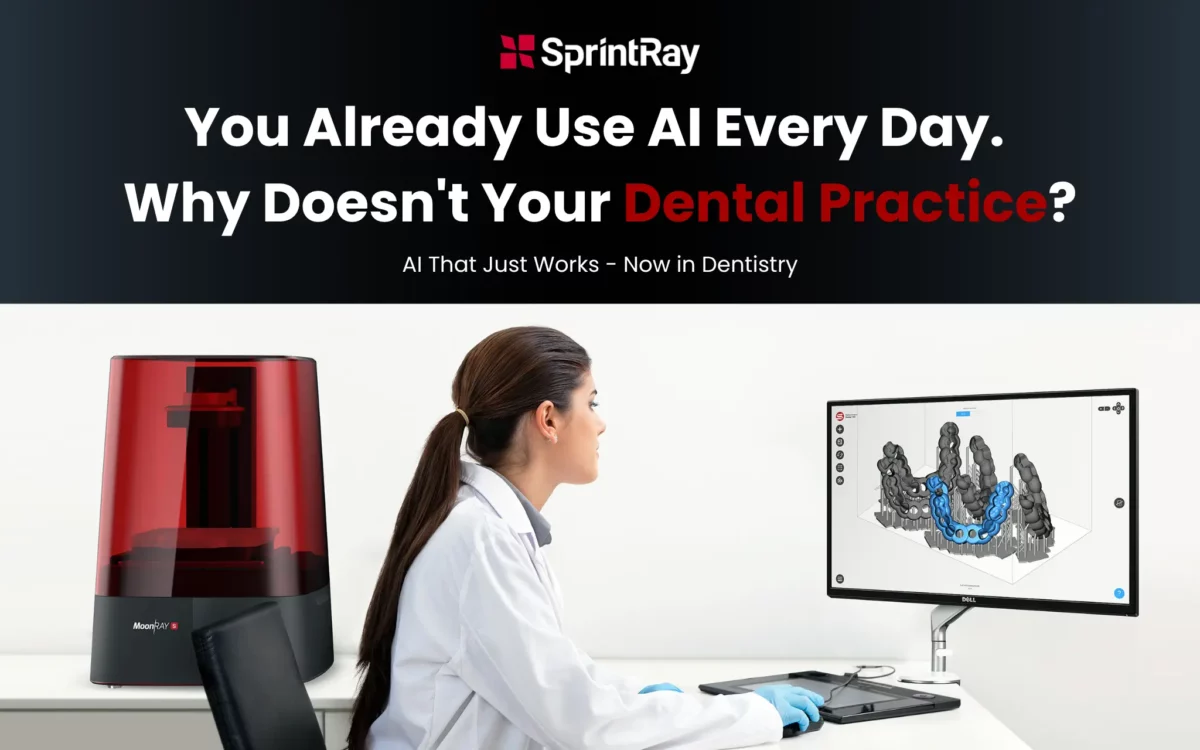
SprintRay Cloud Design uses AI to automate restoration design, taking a digital scan and generating a clinically accurate crown, inlay, or veneer design in minutes. Not a rough starting point that needs heavy manual adjustment. A design that’s ready for review, refinement if needed, and production on a SprintRay Midas or Pro 2.
It’s the same principle as every other AI tool you already use: it handles the repetitive, time-intensive work so you can focus on the decisions that require your clinical judgment.
What AI-Powered Dental Design Actually Does (and Doesn’t Do)
There’s a misconception worth clearing up. AI in dental workflows doesn’t replace the dentist. It removes a bottleneck.
Traditional CAD design for a single dental crown can take a trained technician 15 to 30 minutes of manual work, adjusting margins, contacts, occlusion, anatomy. That’s skilled, valuable labor. But it’s also the step that creates the wait, whether that wait is minutes in a chairside workflow or days when a case is sent to a lab.
AI-powered dental design compresses that step dramatically. Cloud Design processes the scan data, references trained parameters for anatomy and fit, and produces a design that reflects the clinical requirements of the case. The dentist reviews, approves, and sends to print.
That’s not a future promise, it’s a Tuesday morning routine for practices around the country that already run this workflow.
And it gets better over time. AI design systems improve with data. More cases processed means more refined outputs. The tool you use six months from now will be measurably better than the one you start with today, without you doing anything differently.
The Real Cost of Waiting to Adopt Dental AI
The hesitation around dental AI usually isn’t about the technology itself. It’s about timing. Practices tell themselves they’ll adopt it “when it matures” or “when the price comes down” or “next year.”
But waiting has its own cost, and it compounds.
Every case you send to an outside lab for design work is time and margin you’re giving away. Every patient who waits two weeks for a crown that could have been delivered same-day is a patient who experienced your practice as slower than it needed to be. Every hour your team spends on manual design tasks is an hour they’re not spending on patient care, case acceptance, or practice growth.
The practices that adopted AI-driven workflows early didn’t do it because they had bigger budgets or more tech-savvy teams. They did it because they recognized that the gap between how they live and how they practice was costing them something real.
AI in Dentistry Isn’t Exotic. It’s the New Baseline.
Nobody calls themselves a “GPS practice” because they use navigation. Nobody brags about being an “AI email practice” because their inbox has a spam filter.
The same normalization is happening in dental technology, it’s just earlier in the curve. Practices using Cloud Design and SprintRay’s digital workflow aren’t doing anything exotic. They’re doing what every industry eventually does: letting intelligent software handle the work that doesn’t require a human, so the humans can do more of what they’re best at.
You already trust AI with your morning commute. Your practice deserves the same upgrade.
Ready to see what AI-powered dental design looks like in your workflow? Learn more about Cloud Design or explore SprintRay’s complete chairside 3D printing ecosystem.