






What is Digital Dentistry?
Digital dentistry is the use of digital tools, including intraoral scanners, CAD software, and 3D printers, to design and produce dental restorations and appliances instead of relying on physical impressions and outside labs. In practice, it means a clinic captures a patient’s mouth as a 3D file, designs the restoration on screen, and prints or mills it in-house. The result is faster treatment, fewer remakes, and tighter control over quality.
For clinics in Mexico, where patients increasingly compare practices online and expect modern care, this shift is no longer a luxury. It is becoming the baseline for staying competitive in a crowded market.
Why Mexican clinics are switching now
Mexico is one of the largest dental markets in Latin America, with a high density of clinics and labs and a growing base of patients who travel in for treatment. That competition raises the bar. A patient who needs a crown does not want to wear a temporary for two weeks and return for a second appointment if a clinic down the street can finish in one visit.
At the same time, the economics finally makes sense. Equipment prices have dropped; financing is widely available, and the cost per printed part keeps falling. A practice that once sent every model, guide, and night guard to an outside lab can now produce them in-house at a fraction of the price.
The combination of patient demand and better economics is why adoption is accelerating across Mexico.
The core digital workflow: scan, design, print
Every digital case follows the same three steps, and each one removes a delay that used to slow clinics down.
- First comes the scan. An intraoral scanner captures the teeth and soft tissue as a precise 3D file in two to three minutes. There is no impression material, no gagging, and no shipping a physical mold across the city.
- Next is the design. The scan opens in CAD software, where the restoration is designed to fit the case. Modern cloud design tools have simplified this step so much that clinicians no longer need to master complex engineering software. SprintRay Cloud Design, for example, lets a clinic order a designed arch starting at about $75, which removes the steepest part of the learning curve for practices that are just starting out.
- Finally comes the print. A desktop dental 3D printer using Digital Light Processing builds the model, guide, or appliance layer by layer with high precision.
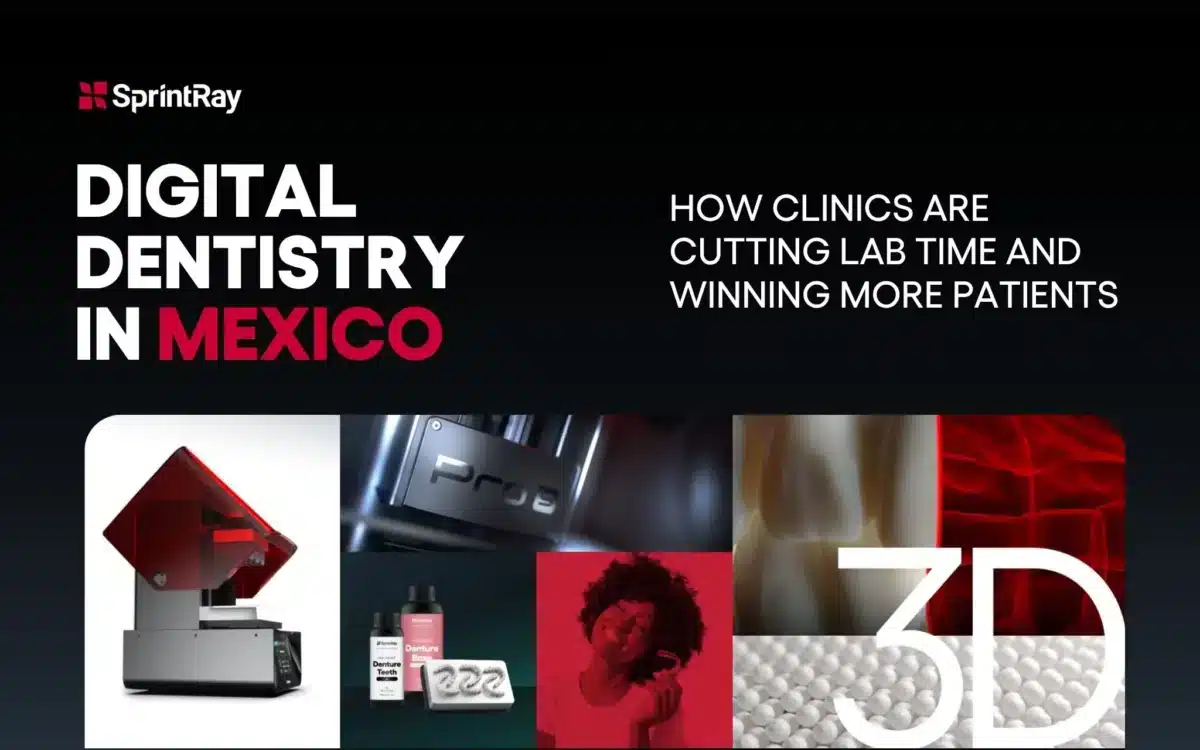
This is where a workhorse printer earns its place: the SprintRay Pro 95S prints up to 30 full-arch models in a single batch, and a built-in platform heater holds accuracy from the first model to the last, so a busy clinic can keep cases moving without a bottleneck. Depending on the case, the finished piece can be ready the same day.
What you can produce chairside
The range of in-office output is wider than most clinics expect. With a single printer and the right resins, a Mexican practice can produce dental models, surgical guides, night guards and occlusal splints, temporary crowns and bridges, try-ins, and full removable dentures. For same-visit fixed work, the SprintRay Midas prints three crowns, six inlays, or nine veneers in under ten minutes, which is what makes a true single-appointment crown possible. For removable, SprintRay’s denture workflow, built around ceramic-infused High Impact denture base and teeth resins, lets a clinic deliver dentures in as few as two visits rather than the four or five a traditional lab cycle often requires.
Bringing this work in-house does two things at once. It shortens treatment timelines for patients, and it converts money that used to leave the practice as lab fees into in-house margin.
The numbers behind the switch
The case for going digital is not just about convenience. The measurable gains are large.
On speed, digital oral scans typically take 2 to 3 minutes, while traditional impressions take 10 to 15 minutes per patient. On accuracy, clinical reviews have found digital scanning to be statistically more accurate than conventional impressions, which means fewer remakes and fewer frustrated return visits. One clinic that adopted chairside 3D printing reported cutting patient wait times by 50 percent.
On cost, the savings compound over time. Industry analyses report that the cost per part can drop 70 to 80 percent for models, splints, and dentures once production moves in-house.
The broader market signal is just as clear: Persistence Market Research projects the global digital dentistry market will reach about US$13.7 billion by 2033 as clinics worldwide move to precision, in-house care.
Traditional workflow vs digital workflow
| Factor | Traditional workflow | Digital workflow |
| Impression time | 10 to 15 minutes | 2 to 3 minutes |
| Accuracy | Prone to distortion and voids | Statistically higher, fewer remakes |
| Visits for a crown | Two or more | Often one |
| Lab dependency | High, every case ships out | Low, most cases stay in-house |
| Per-unit cost over time | Recurring lab fees | Up to 70 to 80 percent lower |
| Patient experience | Messy trays, longer waits | Comfortable scan, faster delivery |
How to start without overspending
The most common mistake is treating digital adoption as a single large purchase. A smarter path for a Mexican clinic is phased.
Start with the workflow that has the clearest return, which is usually models and night guards or removable dentures, because the lab fees there are high, and the cases are frequent. Add an intraoral scanner and a single DLP printer, lean on cloud design so your team does not have to master CAD overnight, and invest in structured training. The learning curve is real but short, and most of the friction disappears once the team runs in ten or fifteen cases. As volume grows, expands into crowns, guides, and more complex prosthetics.
This staged approach keeps upfront cost manageable, generates savings that help fund the next step, and lets the team build confidence before the clinic depends on the equipment for high-stakes cases.
The bottom line for Mexican practices
Digital dentistry is not a trend that clinics can wait out. It is faster for patients, more accurate clinically, and cheaper per unit once the workflow is running. For a Mexican clinic competing for patients who expect modern, same-day care, the question is no longer whether to go digital, but which workflow to bring in-house first. Start where the lab fees are highest, train the team well, and let the early savings fund the rest of the transition.
Frequently Asked Questions
Is digital dentistry better than traditional dentistry?
For most restorative and prosthetic work, yes. Digital workflows are faster, more accurate, and reduce remakes. Traditional methods still have a place, but digital is now the standard of care for crowns, models, guides, and dentures.
How accurate are digital dental impressions?
Very accurate. Clinical reviews have found that digital scanning is statistically more accurate than conventional impressions in many cases, helping reduce remake rates and improve the fit of the final restoration.
How much does it cost to go digitally?
It varies by setup, but costs have fallen sharply. A scanner and a single desktop 3D printer are now within reach for most clinics, and cloud design can start at about $75 per arch, so you do not need to buy expensive CAD software upfront.
Can a small clinic afford 3D printing?
Yes. Many small clinics start with one printer focused on models, night guards, or dentures, where lab fees are highest. The in-house savings often cover the equipment cost within the first year.
What can your 3D printing in a dental office?
Dental models, surgical guides, night guards and splints, temporary crowns and bridges, try-ins, and full removable dentures, all from a single desktop printer with the right resins.